

Official rule set · v.1.1
UTMA Kickboxing Rules
Official Professional Standards & Regulations
These regulations serve as the official rule set for UTMA Kickboxing competitions. For athlete safety, certain decisions remain subject to the professional judgment of the referees.
Contents
1. Equipment
1.1 Compulsory Fighter Equipment
- UTMA Branded T-Shirt: To be worn during the pre-fight ring walk.
- UTMA Branded Fight Shorts: Mandatory for all bouts.
- UTMA x Fairtex Boxing Gloves (10oz): Must be used. Gloves will be secured with blue or red tape (matching the assigned corner) by an official UTMA representative.
- Hand Protection: Velcro bandages or gauze and zinc oxide tape are permitted.
- Mouthguard: Mandatory. It is recommended that cornermen carry a spare.
- Groin Guard: Mandatory for all male competitors.
Note: No additional equipment shall be worn unless the Company has given its prior written approval.
1.2 Hand Wrapping and Taping Regulations
1.2.1 Purpose and General Rules
- Wraps are intended strictly for injury prevention.
- Only zinc oxide tape is permitted; GAFFA-style tape is strictly prohibited.
- Building up layers of tape to pad the knuckles is forbidden.
- No foreign substances, adhesives, hardening agents or any other materials intended to alter the characteristics of the hand wraps.
1.2.2 Taping Guidelines
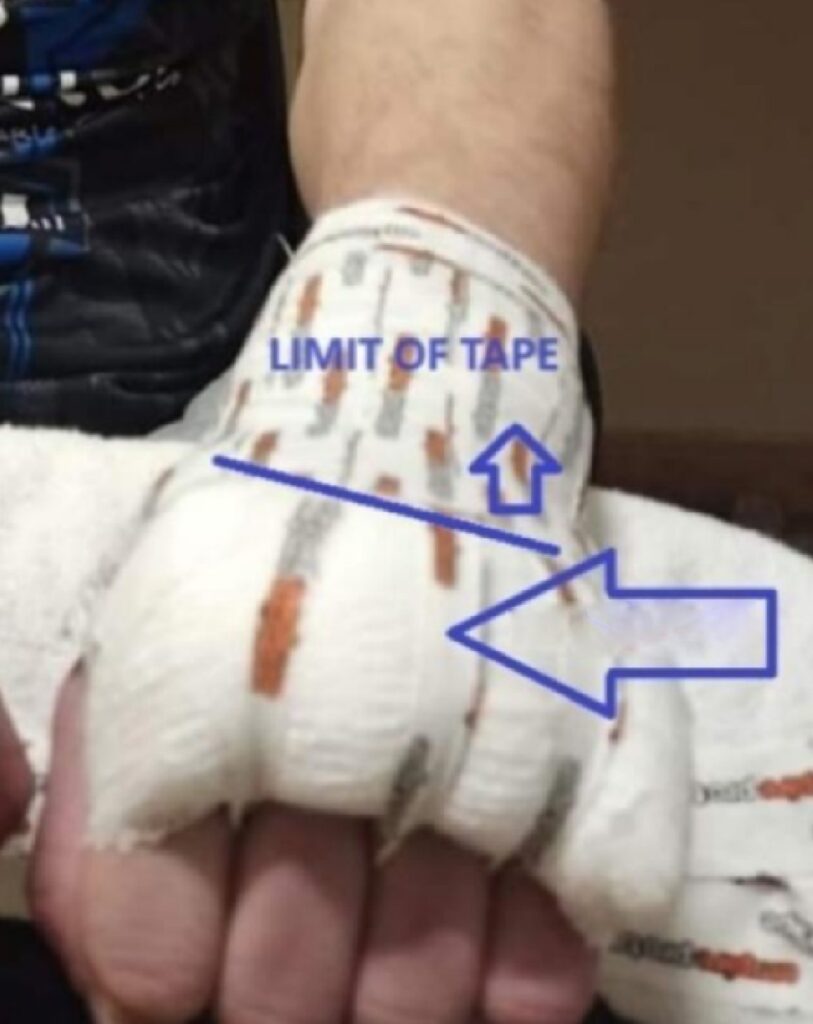
- Soft bandages may be taped up to 2 cm below the knuckles.
- Taping directly over the knuckles is forbidden. Securing tape through the fingers and across the palm is permitted, provided tape thickness does not exceed 1 mm.
1.2.3 Inspection and Approval
All hand wraps must be inspected and signed off by a UTMA representative before boxing gloves are donned.
Failure to comply with the equipment requirements set out in this Section may result, at the Company’s sole discretion, in refusal to allow the Athlete to compete until the non-compliance is remedied, disciplinary sanctions, contractual penalties under the Sports activity contract, or disqualification from the Fight.
2. Techniques
2.1 Legal Strikes
- Standard boxing strikes (straight, cross, uppercut, and hook punches) to the head and body.
- Spinning backfists targeting the head (contact must be made with the padded area of the glove).
- All knee strikes targeting the thighs, body, and head.
- All kicks, including calf kicks.
- Strikes executed while jumping or falling (not allowed to execute the kick when third point of contact is touching the ground)
2.1.1 Clinching and Head Control
Holding an opponent’s head to deliver a knee strike is permitted using both hands. However, only one knee strike is allowed per clinch. The fighter must immediately release the opponent after the strike, or the referee will intervene.
2.1.2 Spinning Backfist Regulations
Fighters must ensure contact is made exclusively with the padded portion of the glove. Contact with the forearm or elbow is illegal. If the strike lands legally and the opponent subsequently moves in, the blow will generally be ruled legal.
2.2 Legal Techniques
- Catching a leg followed immediately by one counter-action (knee, punch, or kick). One step is permitted during this process. The counter-action must be executed immediately upon catching the leg, or the referee will break the engagement. Following the completion of the counter-action, the fighter must release the opponent’s leg immediately; failure to do so will result in an immediate break by the referee.
- Striking an opponent who is in the process of falling.
- Pushing the chest or shoulder area, provided it is immediately followed by an offensive action.
- Pushing an opponent when opponent initiates the clinch
2.3 Illegal Strikes (Fouls)
- Striking the throat, groin, spine, kidneys, or the back of the head. However, if a fighter turns away just before being struck, resulting in the strike landing in these restricted areas, the referee is more likely to rule in favor of the striker rather than the fighter who turned their back.
- Use of elbows, headbutts, biting, spitting, eye gouging, or hair pulling.
- Striking a downed opponent or one in the process of rising. A fighter is “downed” if any part of the body other than the soles of the feet touches the canvas.
- Executing a spinning backfist where contact is made with any part of the arm, wrist, or forearm other than the strictly padded knuckle area of the glove is a banned technique and constitutes a foul.
- Foot sweeps (except for low-kick sweeps to the unweighted calf/foot).
- Punching with the non-padded area of the hand
- Kicking/pushing/teeping opponent’s knee
2.4 Prohibited Techniques
- Catching an opponent’s leg and applying any lock, twisting technique, or excessive force is prohibited. Any force beyond the minimum necessary to lift, pull, or push the leg is prohibited.
- Throwing an opponent using only the hands is not allowed. Additionally, the fighter cannot execute a sweep/throw using their torso, hips, or shoulders. Executing wrestling or judo-style throws, takedowns, foot-hooks, or reaping trips is strictly illegal. Only low-kick sweeps—defined strictly as a clean kick targeting the opponent’s unweighted foot or calf using exclusively the shin or instep—are permitted.
- Grabbing the ring ropes for support or to gain an advantage.
- Deliberately spitting out the mouthguard or falling down to waste time.
- Deliberately falling down
- Running away
- Deliberately attacking an opponent who is stuck in the ropes.
- Fighters may not apply more than a light push to the chest or shoulder area to gain an unfair advantage
- Pushing any area other than chest or shoulders
- Deliberately leaving the ring without the referee’s permission.
3. Discipline for Rule Violations
3.0.1 Step 1: Verbal Warning
Issued for minor infractions without halting the action or the clock.
3.0.2 Step 2: Public Warning
The clock is stopped, and the warning is explicitly signaled to the fighters, corners, and officials.
3.0.3 Step 3: Point Deduction
Mandatory for repeated or intentional fouls. The referee calls a timeout and signals the deduction to the judges and the UTMA Supervisor. The referee may deduct points immediately for significant fouls, even without declaring any prior warnings.
3.0.4 Step 4: Disqualification
The referee retains absolute authority to disqualify a fighter for severe or malicious fouls, resulting in an automatic loss. A disqualification may be issued instantly for a severe violation without any prior warnings or point deductions.
If a fighter has points deducted three times for any violation of the rules, he is automatically disqualified.
If a fighter has points deducted twice for the same violation of the rules, he is automatically disqualified.
3.1 Examples of Time-Wasting Violations
- Fighter Actions:
- Deliberately refusing to stand up from the canvas during the fight, standing up slowly on purpose, turning away to avoid engagement, faking an injury or other types of time wasting → Knockdown count applied.
- Intentionally delaying the start of the next round by refusing to stand up or re-engage → Knockdown count applied.
- Corner Actions (Resulting in Point Deductions):
- Intentionally delaying the fight by not leaving the ring in a timely manner → 1-point deduction.
- Deliberately withholding or excessively delaying the return of the fighter’s mouthguard → 1-point deduction.
- Engaging in any other deliberate actions to stall the fight → 1-point deduction.
All decisions regarding time-wasting penalties are made at the sole discretion of the referee and cannot be contested or argued.
3.2 Cornerman's behavior during a fight (not during the rest period between rounds)/ when one of the fighters is in a neutral corner
Cornermen are prohibited from coaching their fighters during a fight when the referee has paused the action and one or both fighters are positioned in a neutral corner.
4. Recovery and Stoppages
If a fighter is injured by an illegal strike or any other illegal action and cannot continue immediately, they are granted up to five (5) minutes to recover. If they cannot recover, the outcome depends on the nature of the foul:
- If the fighter can not recover within this time, the outcome is determined based on the nature of the foul.
4.1 Outcome Based on the Type of Foul If the Injured Fighter Cannot Recover Within 5 Minutes
4.1.1 Deliberate Fouls
Automatic disqualification for the offending fighter.
4.1.2 Accidental Fouls
- For 3 round fights:
- Round 1, Round 2 or Extra Round: Ruled a No Contest.
- Round 3: If the injured fighter was ahead on the scorecards, they are awarded the win. Otherwise, the bout is a No Contest.
- For 5 round fights:
- Round 1, Round 2, Round 3 or Extra Round: Ruled a No Contest.
- Round 4 onwards: If the injured fighter was ahead on the scorecards, they are awarded the win. Otherwise, the bout is a No Contest.
4.1.3 Fighter Falls Out of the Ring
- If a fighter falls out of the ring due to their own momentum, slip, or carelessness, they have a maximum of twenty (20) seconds to return inside the ring.
- The clock stops only when the fighter is completely inside the ropes and standing on the canvas.
- If the fall was deliberately initiated by the opponent (via legal push or forcing momentum), the fallen fighter is granted a maximum of five minutes to recover under physician evaluation. Note: If the opponent used an illegal technique (foul throw/trip) to force the fighter out, it will be penalized under Section 3.
- Bout Stoppage & Outcome Determination: If a fighter falls out of the ring and is medically ruled unable to continue by the ringside physician, the official outcome is determined by the timeline of the bout:
- Occurrence in Round 1 or an Extra Round: The match is declared a No Contest.
- Occurrence in Round 2 or Round 3: The match is terminated, and the final outcome is determined by a Technical Decision, calculated from the judges’ scorecards of the completed preceding rounds.
- Championship Bouts (Any round after the First): The match is terminated, and the final outcome is determined by a Technical Decision, calculated from the judges’ scorecards of all completed preceding rounds.
Therefore, fighters should aim to win every round, as it can ultimately determine the outcome in critical situations.
5. Referee Commands
5.1 "FIGHT"
Signals the start or resumption of active engagement.
- Fighters are permitted to throw legal strikes and execute authorized techniques immediately upon the referee uttering the command “Fight.”
- Fighters bear the absolute responsibility to protect themselves at all times once the command is given.
5.2 "STOP"
Commands both fighters to immediately cease all actions.
- Fighters must halt all attacks instantly upon the “Stop” command.
- If a strike is already in execution or motion before the command is issued, the referee will determine if the contact was physically unavoidable.
5.3 "BREAK"
Instructs fighters to completely disengage from a clinch or close-range tie-up.
- Upon hearing “Break,” both fighters must immediately disengage and take one full step backward before resuming any offensive attacks.
- Once the single step back is completed, fighters may re-engage immediately; they are not required to wait for a separate command from the referee to resume fighting.
6. Medical Management
In professional kickboxing, blood from the nose and lacerations (cuts) are common occurrences. Referees must carefully manage these situations to balance fighter safety with allowing the contest to continue whenever possible.
6.1 Management of Blood and Lacerations
The referee should allow the fight to continue as much as possible, taking into account:
- The structural severity and location of the cut or nosebleed.
- The amount of time remaining in the current round. If only a short duration remains, the referee should look to allow the fighter to reach the round break for immediate treatment by their cutman.
- The fighter’s ongoing ability to safely defend themselves despite active bleeding.
6.2 When the Referee Should Pause the Fight for Doctor Inspection
The referee must pause the fight, call a medical timeout, and have the fighter examined by the ringside physician if there is an immediate risk to the fighter’s health, specifically:
- Excessive bleeding that runs directly into the eyes, severely impairing vision.
- A deep, gaping, or dangerously located cut (especially on the eyelid or eyebrow line).
- Signs of airway obstruction or potential breathing failure resulting from a severe nosebleed.
6.3 Medical Stoppage Protocol & Authority
The ringside physician is the ultimate authority on a fighter’s medical fitness to continue:
- If the physician determines that the fighter can safely continue, the fight will resume immediately.
- If the physician decides that continuing poses a serious risk to the fighter’s health, they will deliver a medical recommendation to terminate the bout. Upon the physician’s recommendation, the referee will officially stop the match, resulting in a medical stoppage termination.
6.4 Corner’s Authority
The fighter’s corner retains the absolute right to forfeit the match by throwing a towel into the fighting area if they believe their fighter is in imminent danger.
Throwing in the towel results in an immediate stoppage and a loss for that corner via Technical Knockout (TKO). Note: The corner may not throw in the towel while the referee is actively administering a mandatory knockdown count.
These rules ensure that fights are not stopped prematurely while also prioritizing fighter safety and medical oversight when necessary.
7. Bout structure and Scoring System
7.1 Bout Duration
7.1.1 Non-Championship Bouts
- Non-championship bouts consist of three (3) rounds, each lasting three (3) minutes, with a mandatory one (1) minute rest period between rounds.
- If the official judges’ scorecards calculate to a Draw after three completed rounds, a mandatory Extra Round (Extension Round) of three minutes will be held to determine the definitive winner.
- If the bout proceeds to an Extra Round, a minimum one (1) minute rest period will be provided between the third round and the Extra Round.
- In championship title fights, extra rounds may occur:
- If a fight is taking place in which one of the fighters is defending the championship title, no extra rounds are held. If the judges’ scorecards show a tie, the fight is declared a draw.
- If a bout is for a vacant championship title and the judges’ scorecards show a tie, an extra round is declared.
7.1.2 Championship Bouts
- Championship bouts consist of five (5) rounds, each lasting three (3) minutes, with a mandatory one (1) minute rest period between rounds.
- No Extra Rounds are permitted in Championship bouts. If the scorecards are tied the fight will be declared a draw.
7.2 Scoring Criteria (10-Point Must System)
UTMA bouts are scored utilizing the 10-Point Must System. Judges must strictly prioritize their assessment of each round based on the following weighted hierarchy:
Primary Criteria: Knockdowns & Effective Striking (Impact/Damage)
- Knockdowns: A clean knockdown typically results in a 10-8 round score. Multiple knockdowns or absolute structural dominance may result in a 10-7 or 10-6 round.
- Effective Striking: Clean, heavy, and powerful strikes that cause visible impact, cumulative damage (cuts, swelling, structural instability), or heavily stun an opponent hold the highest weight.
Secondary Criteria: Volume & Accuracy
- If the green primary criteria are completely equal, the judge will award the edge to the fighter landing a higher volume of clean, accurate strikes.
Tertiary Criteria: Ring Control, Effective Aggression, & Defense
- Dictating the pace, spatial positioning, and ring control through effective offense holds minor weight. Forward movement without landing effective strikes shall not be scored. Defensive maneuvers hold the lowest possible weight.
Note:
- 🟢 Most Important (Highly Considered by Judges)
- 🟡 Less Important (Can still Considered, but Secondary to Above)
- 🔴 Least Important (Unlikely to Influence the Round Outcome, Often Leading to a Draw)
7.3 Knockdown Regulations
A knockdown occurs when any part of a fighter’s body—excluding the soles of their feet—touches the canvas as a direct result of a legal strike where impact or damage is evident, rather than a mere loss of balance. This also applies if a fighter is visibly unable to maintain equilibrium or becomes unresponsive after absorbing a strike. The round-ending signal (bell/gong) does not override or prevent a knockdown from being ruled or counted.
7.3.1 The 10-Count Protocol & Neutral Corner Rule
When a knockdown occurs, the referee will immediately signal a timeout, separate the fighters, and initiate a mandatory 10-count to assess the fallen fighter’s condition. The referee’s count will only begin or resume once the attacking fighter who scored the knockdown has completely retreated to the farthest neutral corner designated by the referee.
7.3.2 10-Point Must System Scoring Mechanics
Every round is scored independently. The winner of a standard round is awarded 10 points, and the loser is awarded 9 points (10-9 round).
- Dominant Round: If a fighter completely dominates a round without scoring a knockdown, the round is scored 10-8.
- Knockdown Penalty: Any round containing a single official knockdown mandates a score of 10-8 against the knocked-down fighter.
- Multiple Knockdowns: Each additional knockdown suffered by a fighter in the same round will result in a further 1-point reduction (e.g., 10-7 or 10-6 round).
7.3.3 Fighter's Readiness & The Mandatory 8-Count
- Mandatory 8-count: a fighter who is knocked down must receive a mandatory 8-count from the referee. The referee cannot let the bout resume before reaching 8, even if the fighter gets up immediately.
- Assessment at 8: at the count of 8, the referee assesses whether the fighter can safely continue (eyes, balance, response to commands, guard). If the fighter is fit, the referee gives the command “Fight”.
- Knockout (KO): the fighter loses by KO if:
- the referee counts to ten (10) without interruption, because the fighter did not get up or did not reach a fighting position during the count; or
- the referee stops the bout without completing the count because the fighter is unconscious or needs immediate medical help.
- Technical Knockout (TKO): the fighter loses by TKO if:
- the referee reaches the count of 8, assesses the fighter, decides they can’t continue, completes the count of 9 and 10, and stops the bout;
- the referee stops the bout during the action because the fighter can’t defend themselves or is taking excessive punishment, even without a knockdown;
- the knockdown limits in 7.3.5 are reached;
- the corner throws in the towel (see 6.4), or the fighter doesn’t come out when the next round begins;
- the fighter can’t continue because of an injury from a legal technique, including an injury to themselves, such as from a checked kick.
The referee has the final say on whether a fighter is fit to continue, putting fighter safety and fair competition first. If the fight ends because ringside medic stops the fight it will be declared medical stoppage.
7.3.4 Flash Knockdown
A flash knockdown occurs when a fighter is cleanly struck and down, but immediately bounces back to their feet. A flash knockdown might be treated as an official knockdown. In that case the referee must step between the fighters, administer a mandatory 8-count, and the judges must score it as a knockdown round under Section 7.3.2.
7.3.5 Knockdown Limits (The Three-Knockdown Rule)
To preserve athlete safety, strict knockdown limits are enforced:
- A maximum of three (3) knockdowns in a single round results in an automatic termination of the bout via TKO.
- A maximum cumulative total of four (4) knockdowns across the entire duration of the match results in an automatic termination of the bout via TKO.
7.3.6 Standing Knockdown (The Standing 8-Count)
The UTMA applies the standing knockdown rule. If a fighter takes a series of strong, rapid blows, remains standing, but is no longer able to defend himself, or remains standing only because he is pinned against the ropes—even though he is clearly injured—the referee may intervene and perform a mandatory 8-second standing count (Standing 8-Count). This action is treated exactly the same as an official knockdown.
8. Appeals
8.1 Acceptable Grounds for Appeal
Appeals must be based solely on mathematical errors, misapplication of the Rules, or verifiable evidence of collusion. Subjective judging or scoring decisions are final and may not be appealed.
An Intent to Appeal must be submitted by email to [email protected] within two (2) hours following the conclusion of the bout. The full appeal, together with the applicable appeal fee of €600, must be submitted in accordance with the Company’s appeal procedure.
- Mathematical / Clerical Error: An explicit mathematical or clerical error in the addition, calculation, or transcription of the official judges’ scorecards that resulted in an incorrect official result.
- Misapplication of Rules: A clear, objective misinterpretation or incorrect application of the official UTMA Rules by the referee that directly affected the outcome of the bout.
- Collusion: Verifiable evidence of corruption, collusion, or other improper conduct that materially compromised the integrity of the bout or its official result.
8.2 Review of Official Judges' Scorecards
Following the conclusion of the event, only the Athlete’s coach or duly authorized representative may request to review the official judges’ scorecards by contacting the Company’s designated matchmaker.
The official judges’ scorecards constitute confidential records of the Company and may not be copied, photographed, reproduced, distributed, shared, published, or otherwise disclosed to any third party.
Any unauthorized copying or disclosure of the official judges’ scorecards constitutes a breach of these Rules and may result in disciplinary measures or other sanctions at the Company’s sole discretion.
8.3 Submission Timeline & Procedure
- Phase 1 (Intent to Appeal): The fighter, fighter’s management or head coach must submit an email stating their “Intent to Appeal” to [email protected] within two (2) hours of the official conclusion of the specific bout.
- Phase 2 (Full Submission): The complete written appeal, specifying the exact rule violated and accompanied by high-definition video evidence, must be submitted by 12:00 PM (Noon) on the day following the start of the event.
8.4 Appeal Fee Mechanics
- A mandatory appeal processing fee of €600 must be paid to the Company within 24 hours of the full submission. UAB UTMA GRUPĖ LT787300010196954533
- This fee is strictly non-refundable with one exception. If the UTMA Appeals Board rules in favor of the appeal and alters the official bout decision, the €600 fee will be refunded to the applicant in full.
8.5 Evaluation & Adjudication Timeline
All valid appeals will be reviewed by the UTMA Appeals Board (comprising the Tournament Supervisor, UTMA representative, and three independent referees). The board will analyze the official footage, scorecards, and referee reports, and will issue a final, binding written decision within 20 work-days of receiving the fee and documentation.
8.6 Permissible Adjudication Outcomes
If an appeal is approved, the UTMA Appeals Board can only issue one of two official corrections:
- Overturned Decision: The decision is corrected to award the victory to the rightful fighter only in the case of a verified scorecard math error.
- No Contest (NC): If a referee’s misapplication of a rule or a major missed foul directly resulted in the finish of the fight, the original result will be vacated and changed to a permanent “No Contest.” Under no circumstances will a technical error convert a stoppage loss into a victory for the applicant.
9. Bouts with MMA Gloves (4 oz)
The company applies special exceptions for fights conducted under kickboxing rules but using MMA gloves (4 oz). All UTMA kickboxing rules apply in full to these fights, with the following exceptions:
- Knockdown limits: In kickboxing matches fought with MMA gloves (4 oz), different knockdown limits apply – the match ends by technical knockout if a fighter suffers two knockdowns in a single round or three knockdowns over the course of the entire bout.
10. Amendment of the Rules
The Company reserves the right to amend these Rules at any time at its sole discretion. Any amendments shall be communicated to the Fighters by email at least fourteen (14) calendar days before taking effect. Notice of any amendments shall be deemed duly given upon transmission to the Fighter’s last email address provided to the Company. No Fighter’s consent or approval shall be required for any amendment to these Rules. From the effective date, the amended Rules shall automatically replace the previous version and shall be binding on all Fighters participating in Company Events.


